About the Journal
Focus and scope
e-scrita, ISSN 2177-6288, is a biannual scientific publication that aims to disseminate the results of research developed by specialists in the areas of: a) Linguistic Studies, b) Literary Studies, c) Cultural Studies.
Within the scope of Literary Studies, the editions cover: literary theory and criticism; comparative literature; and literatures produced in Portuguese, English, Spanish, and Italian-speaking countries, in dialogue with other fields of knowledge or with other media expressions.
Within the scope of Linguistic Studies, the editions cover linguistic studies in their social context, based on studies describing the formal, cognitive, and communicative aspects of language.
Within the scope of Cultural Studies, the editions cover the forms of production or creation of meanings and their dissemination in contemporary societies; focusing on themes such as gender issues, ethnicity, and the effect of migratory processes.
Texts in the area of teaching methodology will also be published, provided they are linked to one of the three areas mentioned above.
In addition to a thematic dossier, the publication includes other unpublished works in the form of essays and articles, gathered in the "Vária" section, as well as interviews and book reviews of interest to the aforementioned areas. Calls for non-thematic issues may be made at the discretion of the editorial committee.
Peer Review Process
All texts, without exception, will be evaluated by peer reviewers, maintaining mutual anonymity.
Submitted works will be received and evaluated by the Editorial Committee regarding their scientific merit and adherence to the presentation guidelines. After this stage, the works will be sent to two reviewers, members of the editorial committee or ad hoc reviewers, using a blind peer review system. In case of disagreement in the reviews, the text will be submitted to a third reviewer.
The referees will not be paid. Every peer will receive a declaration regarding the evaluation. The peers will have a 20-day deadline to send the comments and observations about the submitted work.
The collaborators, at all steps of submission, evaluation and final decision process, will be informed of (1) the receipt of the paper, (2) the peer evaluation up to (3) the final decision of either the refusal or the acceptance of the paper.
The journal is committed to be aligned with the guidelines established by the Integrity Committee in Scientific Activity from CNPq (http://www.cnpq.br/web/guest/directs) and the ethical recommendations in publication for authors, editors and reviewers of the Committee on Publication Ethics - COPE (http://publicationethics.org/).
Regarding the evaluated material:
In case of the submitted paper presenting relevant content published previously – in other journals or what else means, by the author or third parties, either assertions, arguments or excerpt reproductions –, the evaluators must inform directly to the editors, in order for the collaborators to provide the respective bibliographic reference, indicating its origin. Likewise, when there is substantial similarity or indication that the paper under review has already been published in another medium, the peers should inform the editors that the paper violates the ethical principles of the journal. In this case, the papers will be returned to their authors, with the appropriate explanations about the refusal of submission.
The rules of submissions can be found at the following link:
https://revistasuniabeu.com.br/index.php/revista-e-scrita/submissoes
Open Access Policy
This journal adopts a policy of open and immediate access to published content, ensuring the free availability of its scientific articles to the public. All texts are distributed under the Creative Commons Attribution 4.0 International license (CC BY 4.0), which allows use, distribution, and reproduction in any medium, provided that due credit is given to the authors and the original source.
The journal follows the guidelines established by the Directory of Open Access Journals (DOAJ) for open access publications, understanding that the copyright holder of an academic work authorizes its use by third parties by granting an open license (Creative Commons or equivalent).
This policy guarantees free, public, and permanent access to all content, allowing any user to read, download, copy, distribute, print, search, create links to the full texts, or use them for indexing, software processing, or other legitimate uses, without legal or technical restrictions, subject to the conditions of the applicable license.
All content made available by e-scrita is freely accessible, without an embargo period and without the need for prior registration for consultation or reading.
From 2025 onwards, the journal will have a CC BY 4.0 license.

This work is licensed under Creative Commons Attribution 4.0 International

This journal does not charge any fee for submission, review, publication, distribution or download of articles.
Ethical Publishing Practices
e-scrita is committed to maintaining the highest standards of publishing ethics and takes all possible measures against any irregularities.
All authors, in submitting their works to the journal for publication as original articles, attest that the works presented represent contributions of their authors and do not consist of plagiarism in whole or in part, other works, as well as they agree to grant the journal non-exclusive publication rights, remaining free to make their texts available in other media as long as the publication of the first version in the journal is mentioned.
The journal is committed to a fair evaluation by submitting all submitted papers to a blind peer review.
Any deviations from the above rules should be reported directly to the Chief Editor, who is committed to providing quick solutions.
Antiplagiarism policy
Before submission to the Editorial Committee, external reviewers or at any time during the editorial process, articles submitted to e-scrita will be verified by software for identification of plagiarism and / or autoplagio.
Authors must guarantee the originality of the manuscripts and if they use articles of other authors, that they be duly cited. In this way, it is possible that the authors receive possible questions during the evaluation process of the work submitted, referring to the indications indicated by the software used.
If plagiarism is really proven, the manuscript will be returned to the author.
Plagiarism Detection
http://www.plagiarismcombat.com/
http://www.plagiarismchecker.com/help-teachers.php
http://www.plagscan.com/plagiarism-check/
http://plagiarismdetector.net/
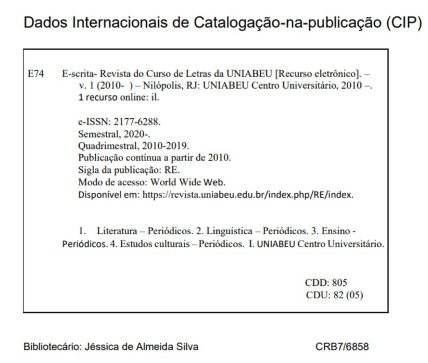
Catalog card
Link to Google Scholar